Toplines
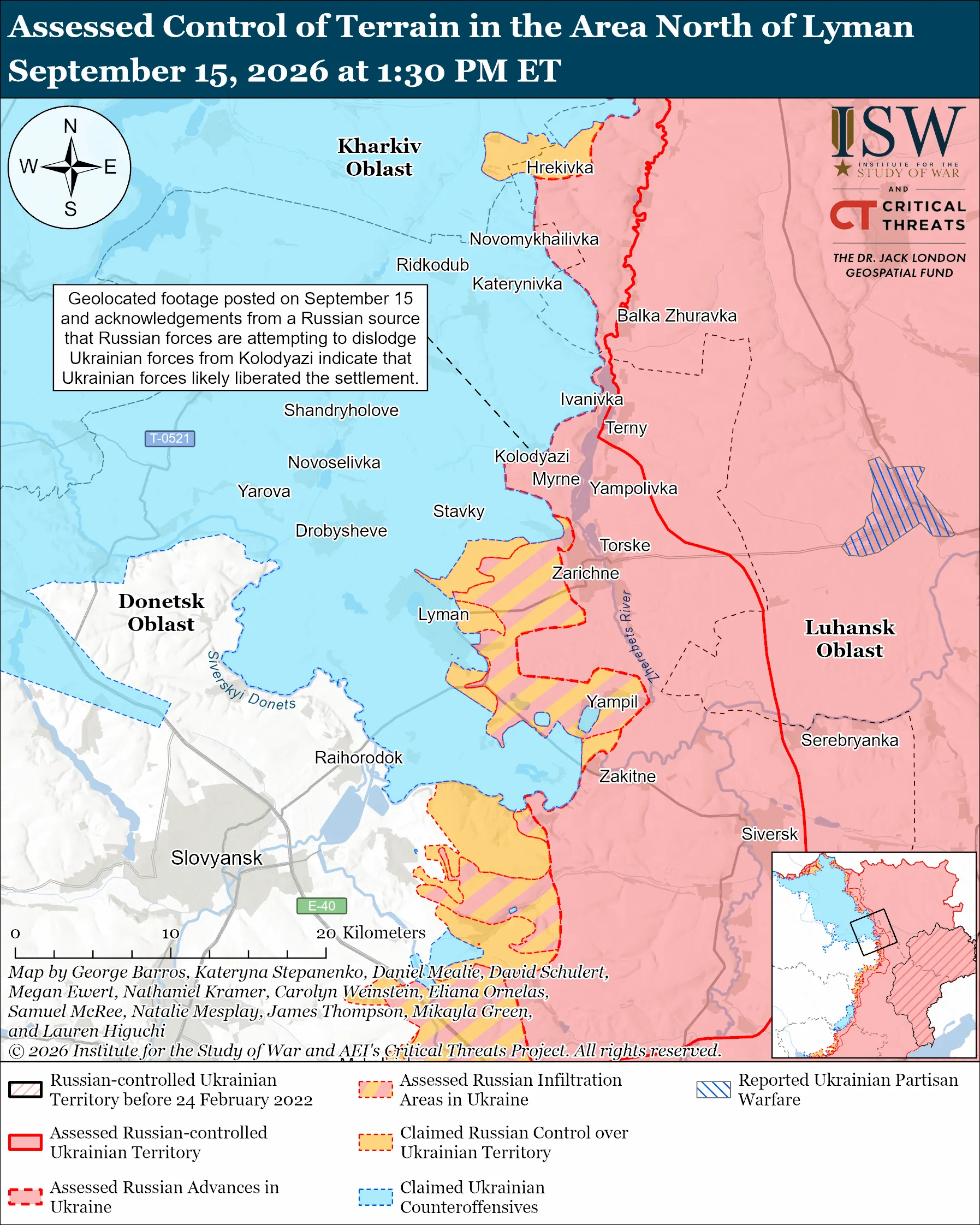
The Ukrainian military gave its first explicit confirmation of ongoing Ukrainian counteroffensive operations against the Russian salient northwest of Lyman. Ukrainian 3rd Army Corps Commander Brigadier General Andrii Biletskyi confirmed on September 15 that Ukrainian forces have been conducting a counteroffensive — Operation Vivaldi — against the Russian salient north of Lyman.[1] Biletskyi stated that Ukrainian forces have cleared or liberated a total of 85 square kilometers, including liberating Serednie (northwest of Lyman) and clearing Russian infiltrators from Novoselivka (south of Serednie), Yarova (southwest of Novoselivka), Oleksandrivka (west of Serednie), and the outskirts of Korovii Yar (northwest of Serednie). Biletskyi noted that these Ukrainian gains were only the first phase of Operation Vivaldi and that Ukrainian forces will continue the operation. Ukrainian forces have likely made additional gains beyond what Biletskyi has reported, and Russian sources are beginning to acknowledge these gains. Russian forces are shelling Ukrainian positions in Kolodyazi (northeast of Lyman) with tube artillery, according to geolocated footage published on September 15.[2] A prominent Russian milblogger additionally acknowledged that Russian forces are attempting to push Ukrainian forces from Kolodyazi — a coy acknowledgement that Ukrainian forces have likely liberated Kolodyazi in conjunction with the geolocated footage.[3] Russian milbloggers and a source reporting on the Russian Western Grouping of Forces continue to indicate that the situation for Russian forces continues to deteriorate in the area, including north and south of Kolodyazi.[4]
The Ukrainian 3rd Army Corps conducted an intermediate-range strike campaign to interdict Russian logistics and degrade fuel supplies as part of Operation Vivaldi. The 3rd Army Corps published an additional video discussing Operation Vivaldi, noting that its drone operators additionally isolated Russian logistics through two stages of strikes: first at depths of up to 50 kilometers from the frontline, then expanding up to 120 kilometers from the frontline.[5] The 3rd Army Corps stated that these Ukrainian strikes forced Russian forces to shut down a pipeline supplying fuel from Russia to occupied Luhansk Oblast; to move support elements of the 144th Motorized Rifle Division (20th Combined Arms Army, Moscow Military District) from occupied Ukraine to Voronezh Oblast; and to disperse Russian fuel and ammunition depots, communications hubs, command posts, and transports, including into Russia and in forests, further inhibiting Russian logistics. Ukrainian forces have been conducting an intermediate-range strike campaign against Russian logistics, particularly tanker trucks and fuel depots, against areas throughout occupied Ukraine since Spring 2026.[6] The 3rd Army Corps campaign against occupied Luhansk Oblast appears to have run concurrently and in conjunction with other strike campaigns, including by Ukraine’s Unmanned Systems Forces. The 3rd Army Corps report corroborates many statements from a source reporting on the Russian Western Grouping of Forces that Russian forces, particularly the 144th Motorized Rifle Division and its subunits, have been struggling with logistics in the Borova and Lyman directions due to Ukraine’s strike campaign into occupied Luhansk Oblast.[7] Ukrainian forces have continued their intermediate-range strike campaign against both occupied Luhansk Oblast in the east and areas of occupied southern Ukraine, and these strikes will likely continue to enable Ukraine to achieve operational effects on the battlefield.[8] Russian forces will likely continue to struggle defending against these strikes as they have thus far because of their air defense and manpower constraints.[9]
Ukraine’s Operation Vivaldi has achieved the operationally-significant objective of disrupting the Russian effort to conduct a wide encirclement of Ukraine’s Fortress Belt. Ukraine’s gains thus far north of Lyman have rendered unfeasible the already-unrealistic Russian plan to encircle the Fortress Belt from the north and south. The prominent Kremlin-affiliated Russian milblogger agreed with ISW’s assessment, acknowledging that Ukraine’s successes will delay Russia’s offensive on Slovyansk — the Russian objective after the seizure of Lyman itself.[10] The milblogger warned that the northern flank of the Russian Southern Grouping of Forces (operating in the area southeast of Lyman and east of Kramatorsk) is now vulnerable to Ukrainian counterattacks and interdiction efforts. The milblogger stated that Russian forces also lost positions south of Lyman and are struggling to recapture positions within Lyman itself because of the Ukrainian advances. Russian milbloggers continue to blame the culture of “beautiful reports,” in which exaggerated claims of Russian advances from battlefield commanders to the higher command impact operational planning, for enabling Ukrainian advances.[11] Another prominent milblogger claimed that some Russian military commanders are attempting to cover up the degree of Russian losses by rapidly forming assault troops of untrained personnel in efforts to recapture territory, but that the higher Russian military command is now aware of the situation on the ground.[12]
Russian forces continue prioritizing attacks aimed at advancing frontally on the Fortress Belt from the south and encircling the Fortress Belt from the southwest over efforts to advance on the cities from the east, even though the Lyman effort has failed.[13] The Russian military command may still be internalizing the loss of the Lyman salient and tactical initiative in the area or may seek to cut Ukrainian ground lines of communication (GLOCs) to the Fortress Belt from the west. The Russian military command also likely seeks to achieve informational effects by continuing to make claimed or actual advances in Donetsk Oblast, Russia’s stated priority effort, that the Kremlin can portray as victories domestically and internationally. Ukraine’s ongoing counteroffensive undermines this Russian cognitive warfare effort, however, and will likely continue to do so as Ukrainian forces continue and later release more information about Operation Vivaldi.
Ukrainian President Volodymyr Zelensky restated on September 15 Ukraine’s willingness to engage in a mutual ceasefire on energy targets with Russia amidst US President Donald Trump’s push for this ceasefire. Zelensky reiterated that Ukraine is prepared to support a mutual halt to strikes against critical infrastructure and take steps towards de-escalation.[14] Zelensky emphasized that Ukraine’s participation in this proposed ceasefire depends on Ukraine’s US partners ensuring that “Russia is truly ready to stop the war” and presumably its strikes against Ukrainian critical infrastructure. Zelensky has repeatedly offered mutual ceasefires, including moratoriums on energy infrastructure strikes, while the Kremlin has repeatedly rejected these offers.[15] Kremlin Spokesperson Dmitry Peskov deflected from the US and Ukrainian-proposed ceasefire on energy infrastructure on September 15. He called the US-proposed ceasefire “a very good idea” and “a good initiative,” but noted that an energy ceasefire will not solve global energy market issues and that Russia needs the West to lift sanctions on Russia to “saturate” the global market with Russian energy.[16]
The Kremlin continues to publicly and explicitly outline its continued commitment to its maximalist war aims in Ukraine and deflect from opportunities for de-escalation. Russian Foreign Minister Sergei Lavrov stated during an embassy roundtable on the situation in Ukraine on September 14 that Russia has not “fundamentally changed its position” from the start of the war, effectively reiterating Russia’s commitment to its original and maximalist war aims.[17] Lavrov reiterated the war aims that Russian President Vladimir Putin first identified before the full-scale invasion: preventing NATO’s expansion on Russia’s borders, ensuring the rights of Russian-speaking people in Ukraine, and Ukraine’s “denazification” and “demilitarization”— referring to Russia’s original aims of severely limiting the Ukrainian military such that Ukraine cannot defend itself, the removal of the current Ukrainian government, and the installation of a pro-Russian puppet government in its place.[18] The Kremlin continues to not engage in good faith with US officials and with Ukraine, to deflect from proposals to de-escalate the war, and instead insists that Ukraine meet all its demands.
A Russian frigate fired flares against a Danish helicopter providing routine surveillance of the frigate in international waters in the Baltic Sea on September 14. The Danish Armed Forces reported on September 14 that a Russian frigate fired two flares at a Danish Air Force Fennec helicopter engaging in surveillance operations in international waters off Gedser and that one of the flares passed within a short distance of the helicopter.[19] Danish Defense Minister Jeppe Bruus stated on September 15 that this was the first incident of its kind and that the incident demonstrates Russia’s increasing willingness to take risks.[20] The Danish Ministry of Foreign Affairs stated on September 15 that this Russian action is completely unacceptable and that Denmark has summoned the Russian ambassador to discuss the incident.[21]
Several sabotage attempts occurred across Europe between September 14 and 15 that are consistent with the modus operandi of Russian military forces and agents, although Russian involvement in them has not been confirmed. The Lithuanian Ministry of National Defense reported on September 15 that Italian fighter jets operating as part of the NATO air defense mission intercepted an unspecified drone in Lithuanian airspace on the night of September 14 to 15.[22] Lithuania’s National Crisis Management Center Head Vilmantas Vitkaukas stated on September 15 that the drone flew from Belarusian airspace and most likely had an explosive device.[23] The Lithuanian Armed Forces stated that Lithuanian authorities are investigating the incident.[24] Italian Defense Minister Guido Crosetto stated on September 15 that the drone was likely Russian, and a Ukrainian military source told Reuters that the drone debris appears to be from a Geran-2.[25] Germany’s State Criminal Police reported that German authorities discovered unspecified drone debris east of Lake Steinheder, just one kilometer away from the Wunstorf Air Base of the German Armed Forces.[26] German outlet Bild stated that German authorities have been aware of the incident since September 14. Dutch State Railway Infrastructure Manager ProRail reported on September 15 that unspecified actors deliberately placed pipes and other materials on railway tracks, causing 35 disruptions to passenger and cargo rail services across the Netherlands that authorities have since resolved.[27] ISW is unable to independently verify the actors responsible for these incidents.
The US Treasury Department announced on September 14 that it imposed additional sanctions against Russian state-majority owned bank VTB for its involvement in Iranian sanctions evasion and increasing Russian-Iranian bilateral trade.[28] The US Treasury Department noted that VTB Bank began increasing its presence in Tehran in January 2025. The United States imposed prior rounds of sanctions against VTB Bank in February 2022 and January 2025 for its affiliation with the Russian state, role in the Russian economy, and facilitation of Russian-People’s Republic of China (PRC) efforts to evade sanctions.[29]
Key Takeaways
- The Ukrainian military gave its first explicit confirmation of ongoing Ukrainian counteroffensive operations against the Russian salient northwest of Lyman.
- The Ukrainian 3rd Army Corps conducted an intermediate-range strike campaign to interdict Russian logistics and degrade fuel supplies as part of Operation Vivaldi.
- Ukraine’s Operation Vivaldi has achieved the operationally-significant objective of disrupting the Russian effort to conduct a wide encirclement of Ukraine’s Fortress Belt.
- Ukrainian President Volodymyr Zelensky restated on September 15 Ukraine’s willingness to engage in a mutual ceasefire on energy targets with Russia amidst US President Donald Trump’s push for this ceasefire.
- The Kremlin continues to publicly and explicitly outline its continued commitment to its maximalist war aims in Ukraine and deflect from opportunities for de-escalation.
- A Russian frigate fired flares against a Danish helicopter providing routine surveillance of the frigate in international waters in the Baltic Sea on September 14.
- Several sabotage attempts occurred across Europe between September 14 and 15 that are consistent with the modus operandi of Russian military forces and agents, although Russian involvement in them has not been confirmed.
- The US Treasury Department announced on September 14 that it imposed additional sanctions against Russian state-majority owned bank VTB for its involvement in Iranian sanctions evasion and increasing Russian-Iranian bilateral trade.
- Ukrainian forces recently advanced in the Lyman direction and the Fortress Belt Outer Encirclement Effort.
- Russian forces launched 200 drones against Ukraine overnight.
- Ukrainian forces conducted a series of long-range drone strikes against oil, defense industrial, and military infrastructure in Russia.
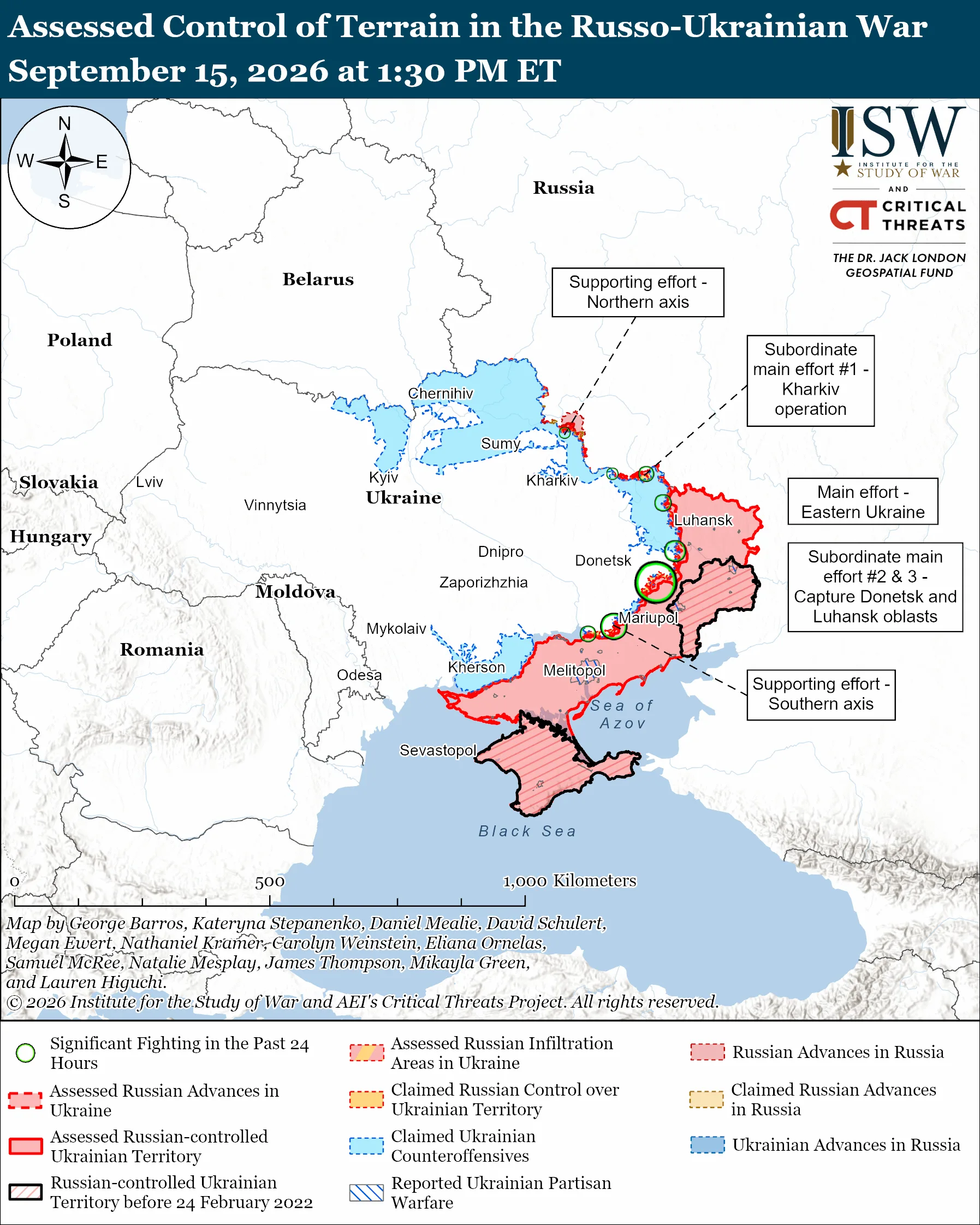
ISW has reorganized its axes in Donetsk and Dnipropetrovsk oblasts to better reflect the Russian campaign to seize Ukraine’s Donetsk Oblast Fortress Belt. ISW will analyze the Russian campaign in Donetsk Oblast in more detail in a forthcoming special edition.
We do not report in detail on Russian war crimes because these activities are well-covered in Western media and do not directly affect the military operations we are assessing and forecasting. We will continue to evaluate and report on the effects of these criminal activities on the Ukrainian military and the Ukrainian population and specifically on combat in Ukrainian urban areas. We utterly condemn Russian violations of the laws of armed conflict and the Geneva Conventions and crimes against humanity even though we do not describe them in these reports.
Ukrainian Operations in the Russian Federation
Ukrainian forces conducted a series of long-range drone strikes against oil, defense industrial, and military infrastructure in Russia. Ukrainian President Volodymyr Zelensky stated on September 15 that Ukrainian forces struck an oil refinery in Syzran, Samara Oblast (approximately 816 kilometers from the frontline); a drone production facility in Taganrog, Rostov Oblast (approximately 177 kilometers from the frontline); a drone preparation and launch site in Oryol Oblast; and unspecified targets in the Black Sea.[30] The Ukrainian General Staff specified on September 15 that Ukrainian forces struck the Atlant Aero facility in Taganrog and the Syzran Oil Refinery, damaging the refinery’s AVT-6 primary oil processing unit and one of its oil tank farms.[31] The Ukrainian General Staff reported that the Syzran Oil Refinery has a processing capacity of approximately 8.9 million tons of oil per year and produces gasoline, diesel, aviation fuel, and other petroleum products, and that the Atlant Aero facility produces Molniya-type strike and reconnaissance drones and Orion reconnaissance drone components. Rostov Oblast Governor Yury Slyusar acknowledged on September 15 that Ukrainian forces struck an Ozon warehouse in Taganrog, and NASA Fire Information for Resource Management System (FIRMS) data confirmed that there were fires at the Ozon warehouse on the grounds of the Rostelmash plant and the Beriev Aircraft Company facility in Taganrog.[32] Ukrainian forces struck a Nebo-M radar system just south of the air base at Millerovo, Rostov Oblast (approximately 170 kilometers from the frontline), based on geolocated footage published on September 15.[33] Geolocated images published on September 14 show smoke rising from the Sebryakov cement facility in Mikhaylovka, Volgograd Oblast (approximately 387 kilometers from the frontline), according to open sources.[34]
Ukrainian and open sources provided updated battlefield damage assessments (BDA) of recent Ukrainian strikes in Krasnodar and Perm krais. The Ukrainian General Staff reported that a Ukrainian September 13 strike against the Slavyansk Oil Refinery in Slavyansk-on-Kuban, Krasnodar Krai (roughly 300 kilometers from the frontline) destroyed three storage tanks and damaged eight more.[35] An open source Telegram channel reported that the Metafrax Chemicals plant in Perm Krai suspended its operations following a Ukrainian September 11 strike.[36]
Russian Supporting Effort: Northern Axis
Russian objective: Create defensible buffer zones in Sumy Oblast along the international border
Russian forces attempted to conduct a platoon-size assault through a gas pipeline north of Sumy City. A Ukrainian brigade operating in Sumy Oblast reported on September 13 that Ukrainian forces killed 29 and wounded three Russian servicemembers who attempted an assault against Mala Korchakivka (north of Sumy City) through a gas pipeline.[37] Russian forces attempted to use pipelines for an infiltration mission in Sumy Oblast on September 12. They used pipes to make significant advances in Avdiivka, Kursk Oblast, and Kupyansk in January 2024, March 2025, and September 2025, respectively.[38]
Ukrainian forces conducted a series of strikes against Russian military assets in Bryansk Oblast. The Ukrainian General Staff reported that Ukrainian forces struck three electronic warfare (EW) stations in Trubchevsk (approximately 24 kilometers from the international border), the “Pochep-2” military settlement (approximately 56 kilometers from the international border), and Rechitsa (one of multiple settlements approximately 46 to 112 kilometers from the international border); air surveillance radar stations in Pogreby (approximately 57 kilometers from the international border) and Mostocheno (approximately 35 kilometers from the international border); and a mesh network relay station in Zlynka (approximately 36 kilometers from the international border) on September 14 and on the night of September 14 to 15.[39]
Russian Supporting Effort: Kharkiv Oblast
Russian objective: Push Ukrainian forces back from the international border to create a defensible buffer zone with Belgorod Oblast and approach Kharkiv City
Russian forces continued limited offensive operations in northern Kharkiv Oblast on September 15 as Ukrainian forces counterattacked near Kozacha Lopan (north of Kharkiv City).[40]
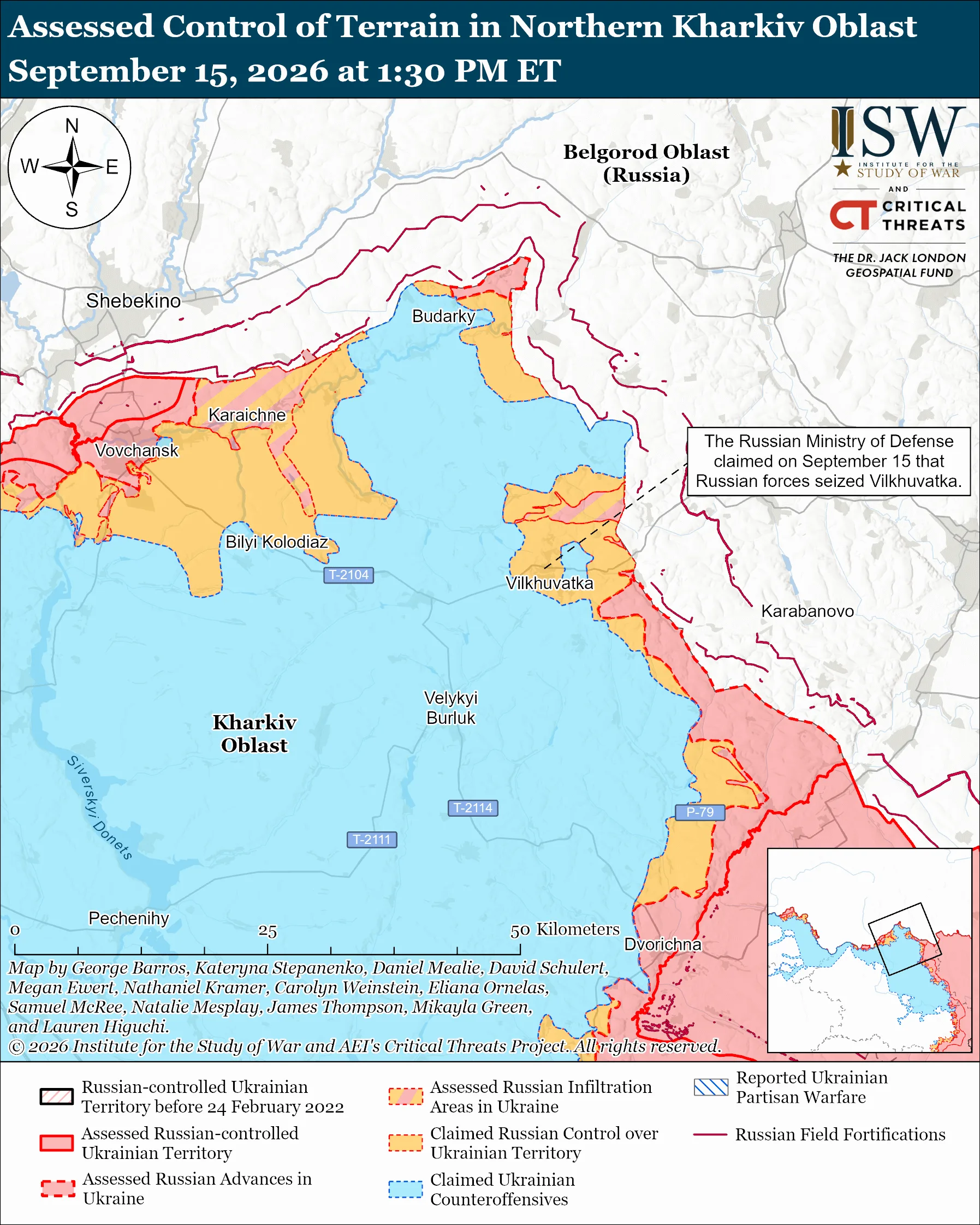
Russian sources continue to argue about the official Russian narrative that Russian forces have encircled Ukrainian forces northeast of Kharkiv City. A Kremlin-affiliated Russian milblogger admitted on September 15 that there is little visual confirmation of the supposed Russian encirclement in the northeastern Kharkiv Oblast.[41] A source reporting on the Russian Northern Grouping of Forces claimed on September 15 that Ukrainian forces maintain control of Blahodatne (northeast of Kharkiv City), Nefedivka, and Chorne (both east of Blahodatne).[42] Russian sources have repeatedly claimed since September 3 that Russian forces encircled Ukrainian units in northeastern Kharkiv Oblast, contrary to all available evidence.[43]
The Russian Ministry of Defense claimed on September 15 that the Russian Northern Grouping of Forces seized Vilkhuvatka (northeast of Velykyi Burluk).[44] ISW has not observed Russian claims that Russian forces have seized the area between Vilkhuvatka and Chuhunivka (just east of Vilkhuvatka), suggesting that some Russian sources are claiming that Russian forces have conducted a tactical encirclement of Ukrainian forces in the middle of a string of settlements north and southeast of Vilkhuvatka.
Russian Supporting Effort: Oskil River
Russian objective: Cross the Oskil River in Kharkiv Oblast and push westward into eastern Kharkiv Oblast and northern Donetsk Oblast
Russian forces continued offensive operations in the Kupyansk and Borova directions on September 14 and 15 but did not advance as Ukrainian forces counterattacked.[45] A source reporting on the Russian Western Grouping of Forces claimed on September 15 that Ukrainian forces counterattacked against Russian salients north and southeast of Kupyansk.[46]
Russian forces are attempting to narrow a Ukrainian bridgehead southeast of Kupyansk as the situation for Russian forces closer to Kupyansk is worsening. Ukrainian Joint Forces Task Force Spokesperson Colonel Viktor Trehubov stated on September 15 that Russian forces are increasing their efforts along the left bank of the Oskil River near Kupyansk, particularly in the Kivsharivka direction (southeast of Kupyansk) where Russian forces are attempting to narrow the Ukrainian bridgehead.[47] Trehubov stated that Russian forces are largely unable to maintain positions on the right bank of the Oskil River closer to Kupyansk itself and are losing territory to Ukrainian forces. Trehubov noted that Russian forces likely do not have sufficient capacity to conduct a large-scale offensive in the coming weeks, but the situation could change if the Russian military command allocates more personnel to this effort.
Russian forces have intensified offensive operations in the Kupyansk direction but have not managed to advance recently, and autumn may stabilize the frontline even further. A non-commissioned officer (NCO) of a Ukrainian battalion reported on September 15 that Russian forces have not made any major advances or conducted large-scale movements over the past six months in the Kupyansk direction, while Ukrainian forces have made some tactical advances.[48] The NCO stated that Russian forces have continued to conduct infiltration missions in the Kupyansk direction while decreasing the intensity of their air strikes for unknown reasons. The NCO noted that it is difficult for Ukrainian forces to detect Russian forces under the ample green foliage but assessed that the frontline may stabilize further during the autumn, likely as foliage concealment decreases. The commander of a Ukrainian battalion reported on September 15 that Russian forces have become more active in the Kupyansk direction in September 2026 after receiving reinforcements.[49] The commander noted that Russian forces now move through open fields rather than windbreaks due to a high density of Ukrainian mines.
Ukrainian forces continued their intermediate-range strike campaign against Russian military assets in occupied Luhansk Oblast. The Ukrainian General Staff reported on September 15 that Ukrainian forces struck a Russian fuel and lubricants depot in Novosvitlivka, Luhansk Oblast (roughly 122 kilometers from the frontline), on September 14 or on the night of September 14 to 15.[50]
Russian Main Effort: Capture Ukraine’s Fortress Belt and complete the seizure of Donetsk Oblast
Russian Subordinate Main Effort #1 – Encircle the Fortress Belt from the northwest
Russian objective: Seize Lyman and cross the Siverskyi Donets River to support a wide encirclement of the Fortress Belt – assessed objective of the Russian 25th Combined Arms Army and Western Grouping of Forces elements
See topline text for further information on Ukrainian counterattacks north of Lyman.
Russian forces continued offensive operations in the Lyman direction on September 14 and 15 but did not advance.[51]
Russian Subordinate Main Effort #2 – Advance on the Fortress Belt from the east
Russian objective: Advance on Slovyansk, Kramatorsk, and Druzhkivka from the east – assessed objective of the Russian 3rd Combined Arms Army and Southern Grouping of Forces elements
Russian forces concentrated offensive operations east of Slovyansk near Kryva Luka and toward Mykolaivka on September 14 and 15 but did not advance.[52] A Russian milblogger claimed that Russian forces seized Popasne and advanced south of Markove (both southeast of Kramatorsk).[53]
Russian forces continue to intensify their battlefield air interdiction (BAI) campaign against Fortress Belt cities, setting conditions for future offensives. An NCO of a Ukrainian brigade reported on September 15 that Russian forces are expanding glide bomb, drone, and multiple-launch rocket system (MLRS) strikes against Slovyansk, Kramatorsk, and Druzhkivka, including striking bridges and logistics routes.[54] The NCO noted that Russian forces are attempting to destroy the cities. Russian glide bomb strikes against the cities in the Fortress Belt aim, in part, to create ruins that Russian infiltrators can use for cover and concealment in the future, and glide bomb strikes against bridges aim to prevent Ukrainian forces from maintaining supply lines to forward units.[55]
Russian Subordinate Main Effort #3 – Advance on the Fortress Belt from the south
Russian objective: Advance on Kostyantynivka and Druzhkivka from the south and southwest, east of the Kazenyi Torets River – assessed objective of the Russian 8th Combined Arms Army and Southern Grouping of Forces elements
Russian forces continued offensive operations near and southwest of Kostyantynivka and southwest of Druzhkivka on September 14 and 15 but did not advance.[56]
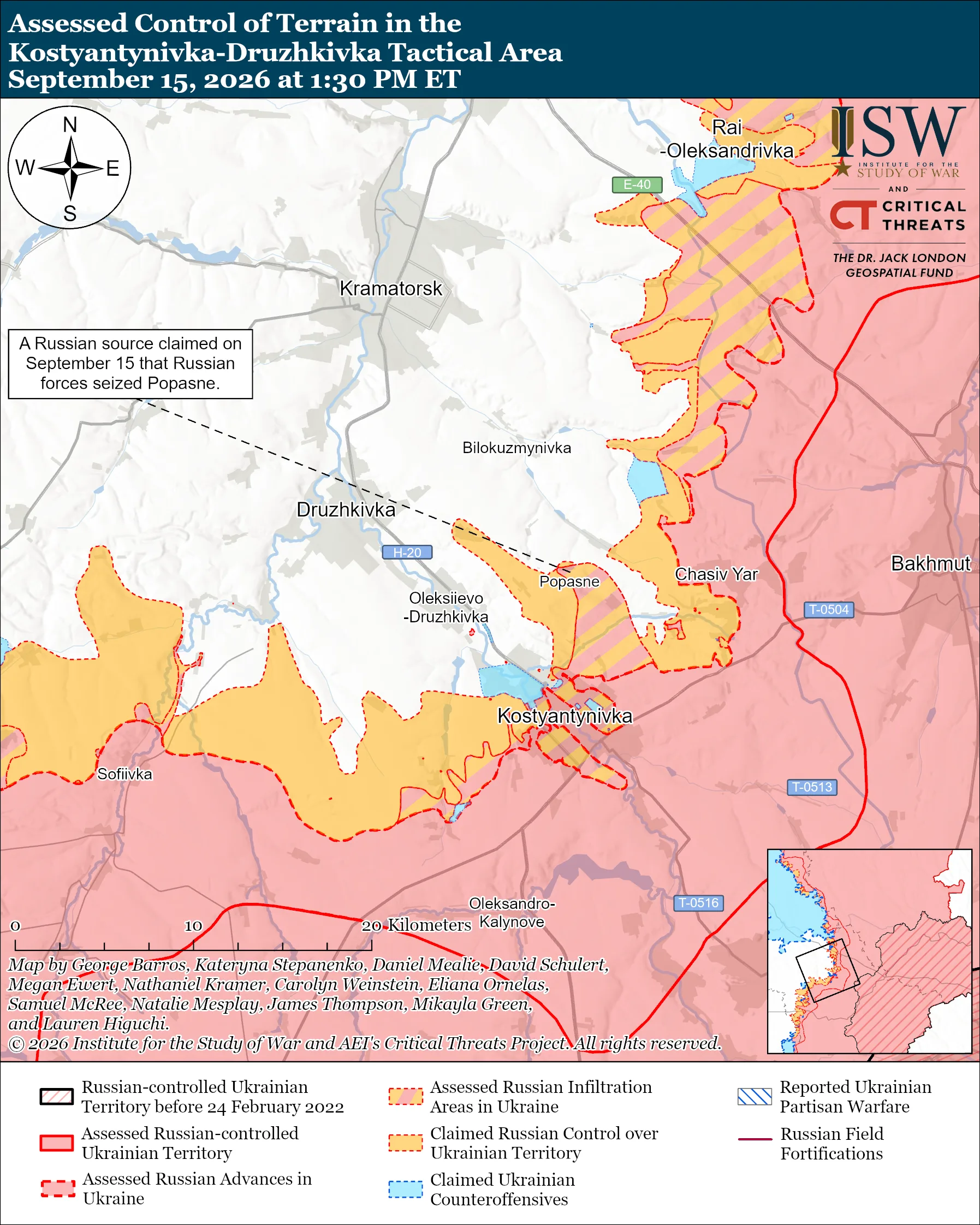
Ukrainian forces continue to refute official Russian claims that Russian forces seized Kostyantynivka. A Ukrainian brigade stated on September 15 that fighting continues closer to Kostyantynivka and published images on September 15 showing Ukrainian personnel operating around Kostyantynivka, refuting Russian claims that Russian forces are within several kilometers of the Kramatorsk Airfield (just southeast of Kramatorsk).[57] Russian President Vladimir Putin claimed that Russian forces seized Kostyantynivka on July 3, and Russian Chief of the General Staff Army General Valery Gerasimov claimed on August 27 that Russian forces were already fighting near the Kramatorsk Airfield.[58] Russian officials continue to make aggrandized and blatantly false claims of Russian advances, contrary to all available evidence.[59]
Russian Subordinate Main Effort #4 – Encircle the Fortress Belt from the southwest
Russian objective: Conduct a wide encirclement of the Fortress Belt from near Dobropillya and Pokrovsk west of the Kazenyi Torets River – assessed objective of the Russian 51st Combined Arms Army and Central Grouping of Forces elements
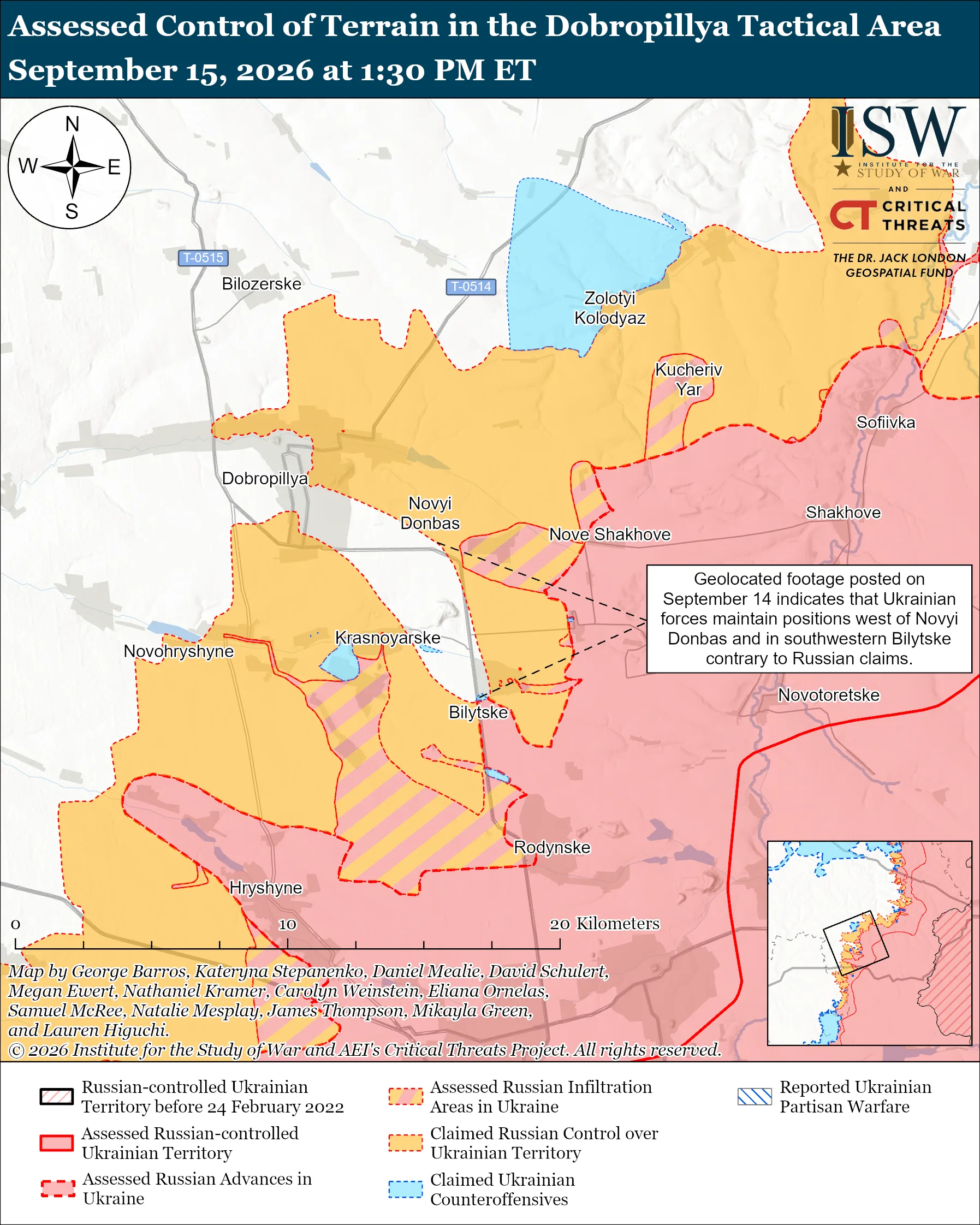
Ukrainian forces recently advanced southwest of Dobropillya. Ukrainian forces recently advanced in southwestern Bilytske (north of Pokrovsk) and advanced or maintained positions in western Bilytske, according to geolocated footage published on September 14 and contrary to Russian claims that Russian forces had advanced in western Bilytske.[60] Russian forces struck Ukrainian positions west of Novyi Donbas (east of Dobropillya), according to geolocated footage published on September 14 and contrary to Russian claims that Russian forces had advanced in the area, indicating that Ukrainian forces advanced or maintained positions in the area.[61] A Russian milblogger claimed on September 14 that Russian forces advanced south of Hulive, in the western outskirts of Serhiivka, and south and west of Novooleksandrivka (all southeast of Dobropillya).[62]
Russian forces are intensifying offensive operations and deploying additional troops in the Dobropillya direction ahead of colder weather. An NCO of a Ukrainian battalion operating in the Dobropillya direction stated on September 15 that Russian forces have been deploying new units and intensifying their attempts to reach Dobropillya over the past few weeks ahead of seasonal changes and loss of foliage.[63] The NCO stated that Russian forces are increasingly using various types of strike drones, improving reconnaissance, and trying to increase the depth of strikes in the area. The NCO noted that Russian fiber-optic drones remain a challenge for Ukrainian forces, as deploying mobile fire groups to logistical routes is the only effective countermeasure. The NCO stated that Russian forces may try to leverage bad weather as cover to transfer a large number of personnel in mechanized columns to the Dobropillya direction, as they previously did in the Pokrovsk direction using fog, but stated that Ukrainian forces are fully prepared for this scenario should Russians decide to do so. The NCO stated that the Russian forces’ ability to organize a large number of infantry groups is limited, mainly due to the need for air support, and assessed that Russian mechanized assaults in the area are unlikely at this time.
Ukrainian forces continued their intermediate-range strike campaign against Russian military assets in occupied Donetsk Oblast. The Ukrainian General Staff reported on September 15 that Ukrainian forces struck a drone storage, preparation, and launch point near Donetsk City (roughly 55 kilometers from the frontline) on September 14 or on the night of September 14 to 15.[64] Ukrainian forces have repeatedly targeted this site in occupied Donetsk City for the past several days.[65] An open-source intelligence source published satellite images from an unspecified date showing damage to the Donetsk City Airport, from which Russian forces launch long-range strike drones against Ukraine.[66] Ukrainian forces struck a Russian Tor-M1 air defense system north of occupied Yehenivka (roughly 40 kilometers from the frontline) according to geolocated footage published on September 14.[67]
Russian Supporting Effort: Advance into Dnipropetrovsk Oblast
Russian objective: Interdict Ukrainian ground lines of communication that support Ukrainian positions in Donetsk Oblast and envelop Ukrainian positions in southwestern Donetsk Oblast – assessed objective of elements of the Russian Central and Eastern groupings of forces
Neither Russian nor Ukrainian sources reported ground activity in the Novopavlivka direction on September 15. A Russian milblogger claimed on September 14 that Russian forces advanced west of Muravka and into Marivka (both northeast of Novopavlivka).[68]
Neither Russian nor Ukrainian sources reported ground activity in the Oleksandrivka direction on September 15.
Russian forces are extensively mining their positions during retreats, complicating Ukrainian clearing operations. A spokesperson for a Ukrainian brigade operating in the Oleksandrivka direction reported on September 15 that Russian forces often mine the territory that they withdrew from with anti-tank and anti-personnel mines and other explosives.[69] The spokesperson stated that Russian forces often disguise or conceal these explosives in ordinary objects like boxes, packages, ammunition magazines, and radio stations, complicating Ukrainian clearing operations. The spokesperson added that the brigade has observed Russian attempts to accumulate forces in the area to seize previously lost positions that Ukrainian forces have liberated since February 2026, but that Russian forces have not conducted a full-fledged rotation. The spokesperson stated that Ukrainian forces are striking Russian equipment in near rear areas, complicating Russian troop movement and logistics.
Russian Supporting Effort: Southern Axis
Russian objective: Maintain frontline positions, secure rear areas against Ukrainian strikes, and advance within tube artillery range of Zaporizhzhia City – assessed objective of the Russian Eastern and Dnepr grouping of forces
Russian forces continued offensive operations in the Hulyaipole direction on September 14 and 15 but did not advance.[70]
Autumnal changes to foliage will likely increase the size of the kill zone and reduce the number of direct combat engagements in the Hulyaipole direction. The commander of a Ukrainian regiment operating in the Hulyaipole direction reported on September 14 that the changing seasons will decrease foliage and offer less vegetative concealment to advancing and infiltrating Russian forces, expanding the kill zone.[71] The commander noted that Russian forces are currently still heavily engaging in fire fights and closely approaching Ukrainian positions.
Ukrainian forces recently advanced or maintained positions in western Zaporizhia Oblast as Russian forces continued limited offensive operations west of Orikhiv.[72] Ukrainian forces maintain positions north of Bilohirya (east of Orikhiv) and in central Orikhiv — in areas where Russian sources previously claimed that Russian forces maintained positions — according to geolocated footage published on September 13 and 14.[73]
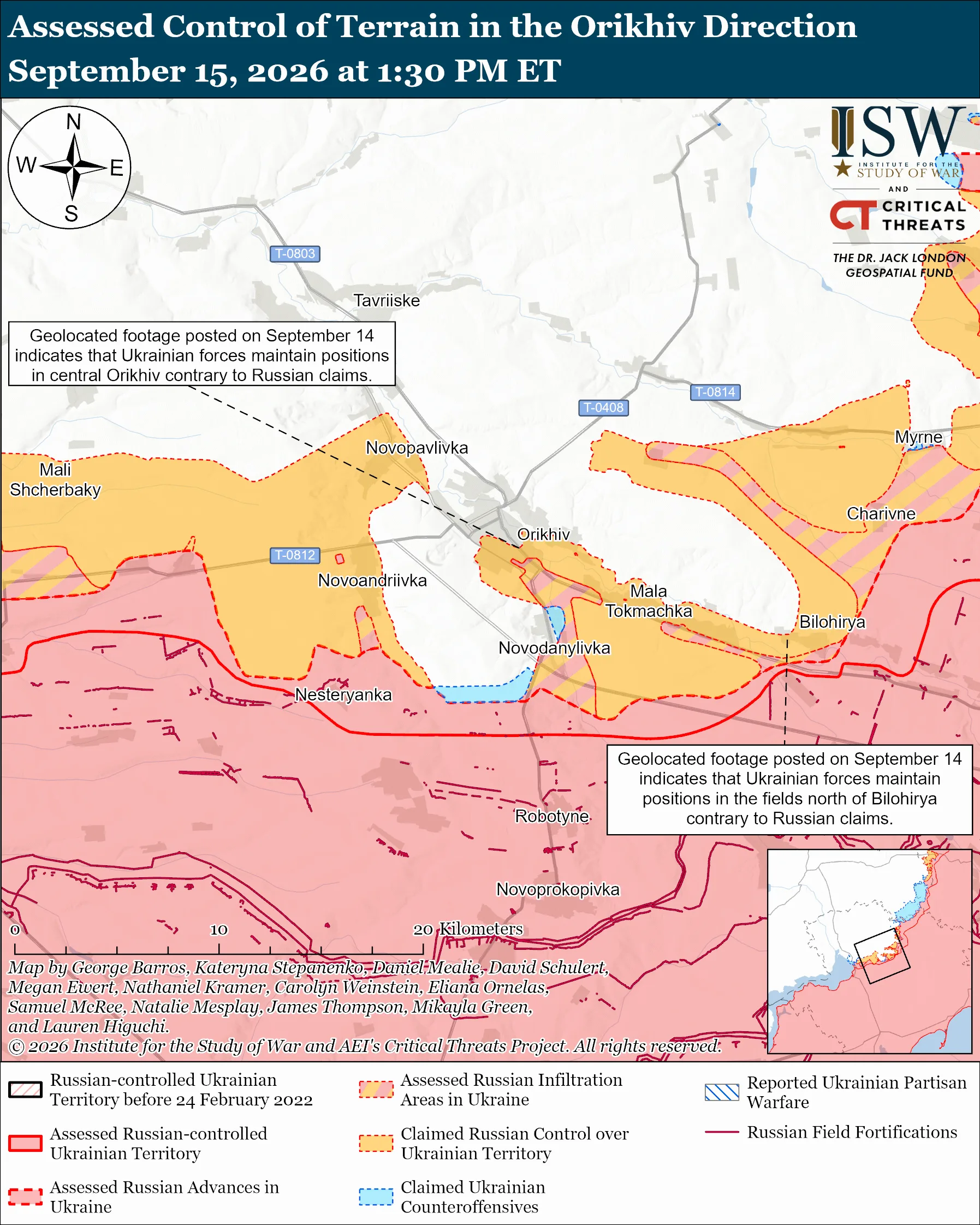
Russian forces continue attempts to connect the Russian Eastern and Dnepr grouping of forces’ (GoF) areas of responsibilities (AoR) southwest of Hulyaipole and northwest of Orikhiv to converge on Orikhiv. A Kremlin-affiliated milblogger claimed that the Russian Dnepr GoF recently advanced in Mala Tokmachka (southeast of Orikhiv), that this advance will enable Russian infiltrations toward Preobrezhenka (just north of Orikhiv), and that the Russian Eastern GoF is supporting these efforts by outflanking Ukrainian forces near Chervona Krynytsya (southwest of Hulyaipole and northeast of Orikhiv).[74] The two GoFs are likely attempting to converge on Ukrainian forces from the western and eastern flanks to seize Orikhiv and subsequently push toward Zaporizhzhia City from the southeast.
Russian sources continue to exaggerate the extent of Russian advances in western Zaporizhia Oblast. A Russian milblogger claimed that Russian forces largely control Orikhiv and are consolidating positions and conducting clearing operations in the town.[75] Russian forces have conducted limited infiltration missions into Orikhiv, but ISW has not observed any evidence to assess that Russian forces have consolidated any positions in the town.
Neither Ukrainian nor Russian sources reported ground activity in the Kherson direction on September 15.
Russian Air, Missile, and Drone Campaign
Russian Objective: Target Ukrainian military and civilian infrastructure in the rear and on the frontline
Note: The Ukrainian military ceased regularly reporting the numbers of Russian missiles fired and the number of missiles intercepted as of August 11.[76]
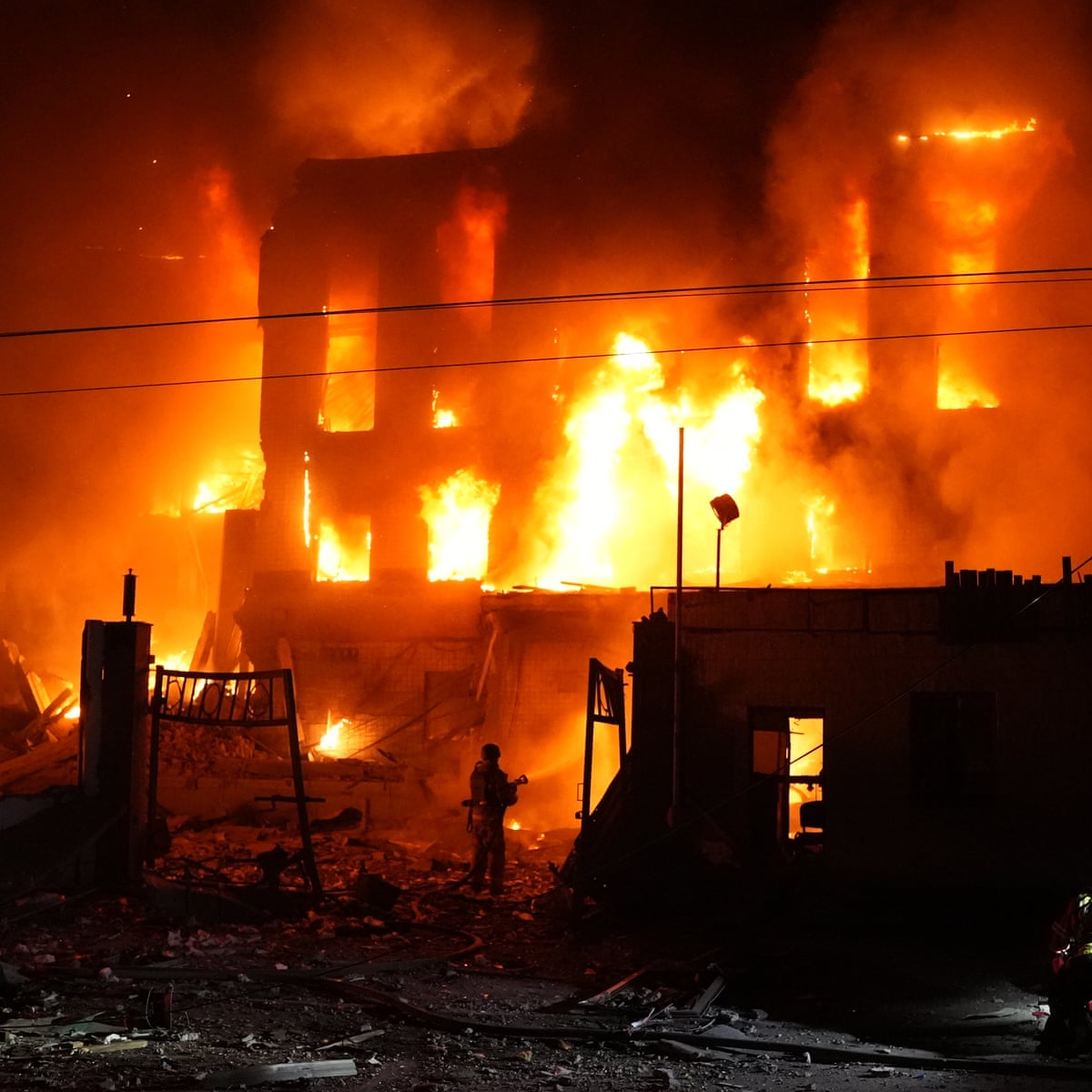
Russian forces conducted a series of drone strikes against Ukraine overnight on September 14 to 15. The Ukrainian Air Force reported that Russian forces launched 200 Shahed-type (including jet powered) and Gerbera-type strike drones and Parodiya-type decoy drones from the directions of Oryol and Kursk cities; Millerovo, Rostov Oblast; occupied Donetsk City; and occupied Hvardiiske, Crimea.[77] The Ukrainian Air Force reported that Ukrainian forces downed 187 drones, that an unspecified number of drones struck seven locations, and that debris fell on 3 locations. Ukrainian officials reported that Russian forces struck residential, transportation, medical, energy, and agricultural infrastructure in Chernihiv, Kharkiv, Kyiv, Odesa, Mykolaiv, and Volyn oblasts.[78]
Russian forces struck Ukrainian fuel infrastructure on September 14 to 15. Kyiv City Mayor Vitaliy Klitschko reported that Russian forces struck two gas stations in Kyiv City, injuring 12 civilians.[79]
Russian forces conducted a drone strike against a train near the Ukrainian-Polish border. Volyn Oblast State Emergency Service reported that Russian forces struck a locomotive in Volyn Oblast on the night of September 14 to 15.[80] Ukrainian railway operator Ukrzaliznytsia Deputy Director for Communications and Customer Experience Oleksandr Shevchenko stated that Russian forces struck the train near the Polish border and that the locomotive crew evacuated before the strike.[81] Russian forces have recently intensified drone strikes against passenger trains and rail infrastructure in Volyn Oblast to disrupt rail traffic in northern Ukraine.[82]
Significant Activity in Belarus
Russian efforts to increase its military presence in Belarus and further integrate Belarus into Russian-favorable frameworks
US Special Envoy for Belarus John Coale reportedly promised Belarusian President Aleksandr Lukashenko that the US would unfreeze Belarusian frozen funds in the US. Reuters reported that Coale met with Lukashenko on September 15 and told Lukashenko that US authorities had asked certain US banks to unfreeze Belarusian funds.[83] Coale and Lukashenko previously met in March 2026, after which Lukashenko announced that he freed 250 political prisoners in exchange for sanctions relief.[84] Lifting US sanctions on Belarus may directly benefit Russia’s war effort, as ISW has assessed that Russia has de facto annexed Belarus and that the states have a combined defense industrial base (DIB).[85]
Note: ISW does not receive any classified material from any source, uses only publicly available information, and draws extensively on Russian, Ukrainian, and Western reporting and social media as well as commercially available satellite imagery and other geospatial data as the basis for these reports. References to all sources used are provided in the endnotes of each update.
Note: ISW does not receive any classified material from any source, uses only publicly available information, and draws extensively on Russian, Ukrainian, and Western reporting and social media as well as commercially available satellite imagery and other geospatial data as the basis for these reports. References to all sources used are provided in the endnotes of each update.

[1] <a href=”https://t.me/ab3army/7468″ rel=”nofollow”>https://t.me/ab3army/7468</a> ; <a href=”https://x.com/ab3army/status/2099850204979544335?s=61&t=EIiKkgLAxjqEyvslu0uXeQ” rel=”nofollow”>https://x.com/ab3army/status/2099850204979544335?s=61&t=EIiKkgLAxjqEyvslu0uXeQ</a>
[2] <a href=”https://x.com/meowqai/status/2099772419544146239″ rel=”nofollow”>https://x.com/meowqai/status/2099772419544146239</a> ; <a href=”https://t.me/official144msd/4743″ rel=”nofollow”>https://t.me/official144msd/4743</a>
[3] <a href=”https://t.me/rybar/83179″ rel=”nofollow”>https://t.me/rybar/83179</a>
[4] <a href=”https://t.me/dva_majors/99047;” rel=”nofollow”>https://t.me/dva_majors/99047;</a> <a href=”https://t.me/rybar/83179;” rel=”nofollow”>https://t.me/rybar/83179;</a> <a href=”https://t.me/dva_majors/99011;” rel=”nofollow”>https://t.me/dva_majors/99011;</a> <a href=”https://t.me/notes_veterans/29811;” rel=”nofollow”>https://t.me/notes_veterans/29811;</a> <a href=”https://t.me/grvZapad/19774″ rel=”nofollow”>https://t.me/grvZapad/19774</a>
[5] <a href=”https://x.com/ab3army/status/2099850204979544335″ rel=”nofollow”>https://x.com/ab3army/status/2099850204979544335</a> ; <a href=”https://armyinform” rel=”nofollow”>https://armyinform</a> dot com.ua/2026/09/15/prymusyly-rosiyan-zgornuty-truboprovid-staly-vidomi-podrobyczi-nastupu-3-go-korpusu/
[6] <a href=”https://understandingwar.org/research/russia-ukraine/ukraines-intermediate-range-strike-campaign-and-new-mechanized-attacks-herald-the-start-of-a-new-phase-of-the-war/;” rel=”nofollow”>https://understandingwar.org/research/russia-ukraine/ukraines-intermediate-range-strike-campaign-and-new-mechanized-attacks-herald-the-start-of-a-new-phase-of-the-war/;</a> <a href=”https://understandingwar.org/research/russia-ukraine/ukraines-strike-campaigns-will-likely-continue-to-hurt-russias-economy-and-military-operations-in-ukraine/;” rel=”nofollow”>https://understandingwar.org/research/russia-ukraine/ukraines-strike-campaigns-will-likely-continue-to-hurt-russias-economy-and-military-operations-in-ukraine/;</a> <a href=”https://understandingwar.org/research/russia-ukraine/russian-offensive-campaign-assessment-june-7-2026/;” rel=”nofollow”>https://understandingwar.org/research/russia-ukraine/russian-offensive-campaign-assessment-june-7-2026/;</a> <a href=”https://understandingwar.org/research/russia-ukraine/russian-offensive-campaign-assessment-june-8-2026/;” rel=”nofollow”>https://understandingwar.org/research/russia-ukraine/russian-offensive-campaign-assessment-june-8-2026/;</a> <a href=”https://understandingwar.org/research/russia-ukraine/russian-offensive-campaign-assessment-may-31-2026/;” rel=”nofollow”>https://understandingwar.org/research/russia-ukraine/russian-offensive-campaign-assessment-may-31-2026/;</a> <a href=”https://understandingwar.org/research/russia-ukraine/russian-offensive-campaign-assessment-june-20-2026/;” rel=”nofollow”>https://understandingwar.org/research/russia-ukraine/russian-offensive-campaign-assessment-june-20-2026/;</a> <a href=”https://understandingwar.org/research/russia-ukraine/russian-offensive-campaign-assessment-june-2-2026/;” rel=”nofollow”>https://understandingwar.org/research/russia-ukraine/russian-offensive-campaign-assessment-june-2-2026/;</a> <a href=”https://understandingwar.org/research/russia-ukraine/russian-offensive-campaign-assessment-september-5-2026/;” rel=”nofollow”>https://understandingwar.org/research/russia-ukraine/russian-offensive-campaign-assessment-september-5-2026/;</a> <a href=”https://understandingwar.org/research/russia-ukraine/russian-offensive-campaign-assessment-august-24-2026/;” rel=”nofollow”>https://understandingwar.org/research/russia-ukraine/russian-offensive-campaign-assessment-august-24-2026/;</a> <a href=”https://understandingwar.org/research/russia-ukraine/russian-offensive-campaign-assessment-june-24-2026/;” rel=”nofollow”>https://understandingwar.org/research/russia-ukraine/russian-offensive-campaign-assessment-june-24-2026/;</a> <a href=”https://understandingwar.org/research/russia-ukraine/russian-offensive-campaign-assessment-july-13-2026/;” rel=”nofollow”>https://understandingwar.org/research/russia-ukraine/russian-offensive-campaign-assessment-july-13-2026/;</a>
[7] <a href=”https://understandingwar.org/research/russia-ukraine/russian-offensive-campaign-assessment-august-24-2026/;” rel=”nofollow”>https://understandingwar.org/research/russia-ukraine/russian-offensive-campaign-assessment-august-24-2026/;</a> <a href=”https://understandingwar.org/research/russia-ukraine/russian-offensive-campaign-assessment-may-31-2026/;” rel=”nofollow”>https://understandingwar.org/research/russia-ukraine/russian-offensive-campaign-assessment-may-31-2026/;</a> <a href=”https://understandingwar.org/research/russia-ukraine/russian-offensive-campaign-assessment-july-4-2026/;” rel=”nofollow”>https://understandingwar.org/research/russia-ukraine/russian-offensive-campaign-assessment-july-4-2026/;</a> <a href=”https://understandingwar.org/research/russia-ukraine/russian-offensive-campaign-assessment-july-1-2026/;” rel=”nofollow”>https://understandingwar.org/research/russia-ukraine/russian-offensive-campaign-assessment-july-1-2026/;</a> <a href=”https://understandingwar.org/research/russia-ukraine/russian-offensive-campaign-assessment-april-16-2026/;” rel=”nofollow”>https://understandingwar.org/research/russia-ukraine/russian-offensive-campaign-assessment-april-16-2026/;</a> <a href=”https://understandingwar.org/research/russia-ukraine/russian-offensive-campaign-assessment-april-4-2026/;” rel=”nofollow”>https://understandingwar.org/research/russia-ukraine/russian-offensive-campaign-assessment-april-4-2026/;</a> <a href=”https://understandingwar.org/research/russia-ukraine/russian-offensive-campaign-assessment-march-23-2026/;” rel=”nofollow”>https://understandingwar.org/research/russia-ukraine/russian-offensive-campaign-assessment-march-23-2026/;</a> <a href=”https://understandingwar.org/research/russia-ukraine/russian-offensive-campaign-assessment-may-24-2026/;” rel=”nofollow”>https://understandingwar.org/research/russia-ukraine/russian-offensive-campaign-assessment-may-24-2026/;</a>
[8] <a href=”https://understandingwar.org/research/russia-ukraine/russian-offensive-campaign-assessment-september-14-2026/” rel=”nofollow”>https://understandingwar.org/research/russia-ukraine/russian-offensive-campaign-assessment-september-14-2026/</a> ; <a href=”https://understandingwar.org/research/russia-ukraine/russian-offensive-campaign-assessment-march-15-2026/” rel=”nofollow”>https://understandingwar.org/research/russia-ukraine/russian-offensive-campaign-assessment-march-15-2026/</a> ; <a href=”https://understandingwar.org/research/russia-ukraine/russian-offensive-campaign-assessment-september-12-2026/” rel=”nofollow”>https://understandingwar.org/research/russia-ukraine/russian-offensive-campaign-assessment-september-12-2026/</a> ; <a href=”https://understandingwar.org/research/russia-ukraine/russian-offensive-campaign-assessment-september-11-2026/” rel=”nofollow”>https://understandingwar.org/research/russia-ukraine/russian-offensive-campaign-assessment-september-11-2026/</a> ; <a href=”https://understandingwar.org/research/russia-ukraine/russian-offensive-campaign-assessment-september-10-2026/” rel=”nofollow”>https://understandingwar.org/research/russia-ukraine/russian-offensive-campaign-assessment-september-10-2026/</a> ; <a href=”https://understandingwar.org/research/russia-ukraine/russian-offensive-campaign-assessment-september-8-2026/” rel=”nofollow”>https://understandingwar.org/research/russia-ukraine/russian-offensive-campaign-assessment-september-8-2026/</a> ;
[9] <a href=”https://understandingwar.org/research/russia-ukraine/russian-offensive-campaign-assessment-april-6-2026/” rel=”nofollow”>https://understandingwar.org/research/russia-ukraine/russian-offensive-campaign-assessment-april-6-2026/</a> ; <a href=”https://understandingwar.org/research/russia-ukraine/russian-offensive-campaign-assessment-august-28-2026/” rel=”nofollow”>https://understandingwar.org/research/russia-ukraine/russian-offensive-campaign-assessment-august-28-2026/</a> ; <a href=”https://understandingwar.org/research/russia-ukraine/russian-offensive-campaign-assessment-june-22-2026/” rel=”nofollow”>https://understandingwar.org/research/russia-ukraine/russian-offensive-campaign-assessment-june-22-2026/</a> ; <a href=”https://understandingwar.org/research/russia-ukraine/russian-offensive-campaign-assessment-july-30-2026/” rel=”nofollow”>https://understandingwar.org/research/russia-ukraine/russian-offensive-campaign-assessment-july-30-2026/</a> ; <a href=”https://understandingwar.org/research/russia-ukraine/russian-offensive-campaign-assessment_24-2/” rel=”nofollow”>https://understandingwar.org/research/russia-ukraine/russian-offensive-campaign-assessment_24-2/</a> ; <a href=”https://understandingwar.org/research/russia-ukraine/russian-offensive-campaign-assessment-april-6-2026/” rel=”nofollow”>https://understandingwar.org/research/russia-ukraine/russian-offensive-campaign-assessment-april-6-2026/</a> ; <a href=”https://understandingwar.org/research/russia-ukraine/russian-offensive-campaign-assessment_30-8/” rel=”nofollow”>https://understandingwar.org/research/russia-ukraine/russian-offensive-campaign-assessment_30-8/</a> ; <a href=”https://understandingwar.org/research/russia-ukraine/russian-offensive-campaign-assessment-october-22-2025/” rel=”nofollow”>https://understandingwar.org/research/russia-ukraine/russian-offensive-campaign-assessment-october-22-2025/</a> ; <a href=”https://understandingwar.org/research/russia-ukraine/russian-offensive-campaign-assessment-april-6-2026/” rel=”nofollow”>https://understandingwar.org/research/russia-ukraine/russian-offensive-campaign-assessment-april-6-2026/</a> ; <a href=”https://understandingwar.org/research/russia-ukraine/russian-offensive-campaign-assessment_25-10/” rel=”nofollow”>https://understandingwar.org/research/russia-ukraine/russian-offensive-campaign-assessment_25-10/</a> ; <a href=”https://understandingwar.org/research/russia-ukraine/russian-offensive-campaign-assessment-july-9-2026/” rel=”nofollow”>https://understandingwar.org/research/russia-ukraine/russian-offensive-campaign-assessment-july-9-2026/</a>
[10] <a href=”https://t.me/rybar/83179″ rel=”nofollow”>https://t.me/rybar/83179</a>
[11] <a href=”https://t.me/dva_majors/99047;” rel=”nofollow”>https://t.me/dva_majors/99047;</a> <a href=”https://t.me/rybar/83179″ rel=”nofollow”>https://t.me/rybar/83179</a> ; <a href=”https://understandingwar.org/research/russia-ukraine/russian-offensive-campaign-assessment-august-26-2026/” rel=”nofollow”>https://understandingwar.org/research/russia-ukraine/russian-offensive-campaign-assessment-august-26-2026/</a> ; <a href=”https://understandingwar.org/research/russia-ukraine/russian-offensive-campaign-assessment-may-16-2026/” rel=”nofollow”>https://understandingwar.org/research/russia-ukraine/russian-offensive-campaign-assessment-may-16-2026/</a> ; <a href=”https://understandingwar.org/research/russia-ukraine/russian-offensive-campaign-assessment-september-6-2026/” rel=”nofollow”>https://understandingwar.org/research/russia-ukraine/russian-offensive-campaign-assessment-september-6-2026/</a> ; <a href=”https://understandingwar.org/research/russia-ukraine/russian-offensive-campaign-assessment-september-9-2026/” rel=”nofollow”>https://understandingwar.org/research/russia-ukraine/russian-offensive-campaign-assessment-september-9-2026/</a> ; <a href=”https://understandingwar.org/research/russia-ukraine/russian-offensive-campaign-assessment-september-1-2026/” rel=”nofollow”>https://understandingwar.org/research/russia-ukraine/russian-offensive-campaign-assessment-september-1-2026/</a>
[12] <a href=”https://t.me/dva_majors/99047″ rel=”nofollow”>https://t.me/dva_majors/99047</a>
[13] <a href=”https://understandingwar.org/research/russia-ukraine/russian-offensive-campaign-assessment-september-13-2026/” rel=”nofollow”>https://understandingwar.org/research/russia-ukraine/russian-offensive-campaign-assessment-september-13-2026/</a>
[14] <a href=”https://t.me/V_Zelenskiy_official/20874;” rel=”nofollow”>https://t.me/V_Zelenskiy_official/20874;</a> <a href=”https://t.me/V_Zelenskiy_official/20872″ rel=”nofollow”>https://t.me/V_Zelenskiy_official/20872</a>
[15] <a href=”https://understandingwar.org/research/russia-ukraine/russian-offensive-campaign-assessment-september-14-2026/;” rel=”nofollow”>https://understandingwar.org/research/russia-ukraine/russian-offensive-campaign-assessment-september-14-2026/;</a> <a href=”https://understandingwar.org/research/russia-ukraine/russian-offensive-campaign-assessment-september-13-2026/” rel=”nofollow”>https://understandingwar.org/research/russia-ukraine/russian-offensive-campaign-assessment-september-13-2026/</a> ; <a href=”https://understandingwar.org/research/russia-ukraine/russian-offensive-campaign-assessment-september-5-2026/;” rel=”nofollow”>https://understandingwar.org/research/russia-ukraine/russian-offensive-campaign-assessment-september-5-2026/;</a> <a href=”https://understandingwar.org/research/russia-ukraine/russian-offensive-campaign-assessment-september-12-2026/;” rel=”nofollow”>https://understandingwar.org/research/russia-ukraine/russian-offensive-campaign-assessment-september-12-2026/;</a> <a href=”https://www.president” rel=”nofollow”>https://www.president</a> dot gov.ua/news/ukrayina-gotova-dotrimuvatisya-rezhimu-pripinennya-povitryan-106265; <a href=”https://understandingwar.org/research/russia-ukraine/russian-offensive-campaign-assessment-june-4-2026/;” rel=”nofollow”>https://understandingwar.org/research/russia-ukraine/russian-offensive-campaign-assessment-june-4-2026/;</a> <a href=”https://understandingwar.org/research/russia-ukraine/russian-offensive-campaign-assessment-august-23-2026/” rel=”nofollow”>https://understandingwar.org/research/russia-ukraine/russian-offensive-campaign-assessment-august-23-2026/</a>
[16] <a href=”https://www.rbc” rel=”nofollow”>https://www.rbc</a> dot ru/politics/15/09/2026/6aa91c3d9c9b458d46a3cc2c; <a href=”https://tass” rel=”nofollow”>https://tass</a> dot com/politics/2187917
[17] <a href=”https://www.rbc” rel=”nofollow”>https://www.rbc</a> dot ru/politics/15/09/2026/6aa910cf335fc83cdd7cbbf1?utm_source=telegram&utm_medium=messenger&utm_campaign=rbc_news&utm_content=6aa910cf335fc83cdd7cbbf1; <a href=”https://rutube” rel=”nofollow”>https://rutube</a> dot ru/video/13d53a2ee4beece14af5f7d7c99b57d6/
[18] <a href=”https://understandingwar.org/research/russia-ukraine/russian-offensive-campaign-assessment-february-19-2026/” rel=”nofollow”>https://understandingwar.org/research/russia-ukraine/russian-offensive-campaign-assessment-february-19-2026/</a> ; <a href=”https://understandingwar.org/research/russia-ukraine/russian-offensive-campaign-assessment-november-10-2025/” rel=”nofollow”>https://understandingwar.org/research/russia-ukraine/russian-offensive-campaign-assessment-november-10-2025/</a> ; <a href=”https://understandingwar.org/research/russia-ukraine/russian-offensive-campaign-assessment-december-19-2025/” rel=”nofollow”>https://understandingwar.org/research/russia-ukraine/russian-offensive-campaign-assessment-december-19-2025/</a> ; <a href=”https://understandingwar.org/research/russia-ukraine/russian-offensive-campaign-assessment-december-18-2025/” rel=”nofollow”>https://understandingwar.org/research/russia-ukraine/russian-offensive-campaign-assessment-december-18-2025/</a> ; <a href=”https://understandingwar.org/research/russia-ukraine/russian-offensive-campaign-assessment-december-17-2025/;” rel=”nofollow”>https://understandingwar.org/research/russia-ukraine/russian-offensive-campaign-assessment-december-17-2025/;</a> <a href=”https://understandingwar.org/research/russia-ukraine/russian-offensive-campaign-assessment-february-19-2026/” rel=”nofollow”>https://understandingwar.org/research/russia-ukraine/russian-offensive-campaign-assessment-february-19-2026/</a>
[19] <a href=”https://www” rel=”nofollow”>https://www</a> dot forsvaret.dk/da/nyheder/2026/forsvarets-helikopter-beskudt-med-flares-fra-russisk-fregat/
[20] <a href=”https://www.ft.com/content/b49762b0-2f8a-457d-bd3a-2820f1fff346?syn-25a6b1a6=1″ rel=”nofollow”>https://www.ft.com/content/b49762b0-2f8a-457d-bd3a-2820f1fff346?syn-25a6b1a6=1</a>
[21] <a href=”https://x.com/DanishMFA/status/2099736913850605731″ rel=”nofollow”>https://x.com/DanishMFA/status/2099736913850605731</a>
[22] <a href=”https://x.com/MinisteroDifesa/status/2099748790466969898″ rel=”nofollow”>https://x.com/MinisteroDifesa/status/2099748790466969898</a>
[23] <a href=”https://www” rel=”nofollow”>https://www</a> dot lrt.lt/naujienos/lietuvoje/2/3052578/nkvc-drono-numusimo-vietoje-ivestas-planas-skydas-apziurimos-surinktos-nuolauzos
[24] <a href=”https://www” rel=”nofollow”>https://www</a> dot lrt.lt/naujienos/lietuvoje/2/3052578/nkvc-drono-numusimo-vietoje-ivestas-planas-skydas-apziurimos-surinktos-nuolauzos
[25] <a href=”https://www.reuters.com/business/aerospace-defense/nato-fighter-shoots-down-drone-lithuania-2026-09-14/” rel=”nofollow”>https://www.reuters.com/business/aerospace-defense/nato-fighter-shoots-down-drone-lithuania-2026-09-14/</a>
[26] <a href=”https://www” rel=”nofollow”>https://www</a> dot bild.de/news/inland/grosseinsatz-der-polizei-drohne-nahe-militaerflugplatz-wunstorf-abgestuerzt-6aa93fee176f7c20b935dbbc
[27] <a href=”https://www” rel=”nofollow”>https://www</a> dot prorail.nl/nieuws/sectiestoring-veroorzaakt-grote-hinder-voor-treinverkeer-in-midden–en-noord-nederland ; <a href=”https://www.ndr” rel=”nofollow”>https://www.ndr</a> dot de/nachrichten/niedersachsen/hannover_weser-leinegebiet/drohne-stuerzt-nahe-steinhuder-meer-ab-grosseinsatz-der-polizei,drohne-458.html
[28] <a href=”https://home.treasury.gov/news/press-releases/sb0629/” rel=”nofollow”>https://home.treasury.gov/news/press-releases/sb0629/</a>
[29] <a href=”https://home.treasury.gov/news/press-releases/jy2785;” rel=”nofollow”>https://home.treasury.gov/news/press-releases/jy2785;</a> <a href=”https://home.treasury.gov/news/press-releases/jy0608″ rel=”nofollow”>https://home.treasury.gov/news/press-releases/jy0608</a>
[30] <a href=”https://x.com/ZelenskyyUa/status/2099780595144331425″ rel=”nofollow”>https://x.com/ZelenskyyUa/status/2099780595144331425</a>
[31] <a href=”https://t.me/GeneralStaffZSU/42242″ rel=”nofollow”>https://t.me/GeneralStaffZSU/42242</a>
[32] <a href=”https://t.me/Yuri_Slusar/7145;” rel=”nofollow”>https://t.me/Yuri_Slusar/7145;</a> <a href=”https://firms.modaps.eosdis.nasa.gov/map/#d:24hrs;%4038.879%2C47.220%2C13.808z;” rel=”nofollow”>https://firms.modaps.eosdis.nasa.gov/map/#d:24hrs;@38.879,47.220,13.808z;</a> <a href=”https://x.com/Osinttechnical/status/2099711199852032436″ rel=”nofollow”>https://x.com/Osinttechnical/status/2099711199852032436</a> ; <a href=”https://militarnyi” rel=”nofollow”>https://militarnyi</a> dot com/uk/news/drony-urazyly-sklad-ozon-ta-aerodrom/
[33] <a href=”https://x.com/MikiValbuena/status/2099778069661712581″ rel=”nofollow”>https://x.com/MikiValbuena/status/2099778069661712581</a> ; <a href=”https://t.me/fedorenkoys/2044″ rel=”nofollow”>https://t.me/fedorenkoys/2044</a>
[34] <a href=”https://t.me/exilenova_plus/30972;” rel=”nofollow”>https://t.me/exilenova_plus/30972;</a> <a href=”https://t.me/DniproOfficial/8160″ rel=”nofollow”>https://t.me/DniproOfficial/8160</a>
[35] <a href=”https://t.me/GeneralStaffZSU/42242;” rel=”nofollow”>https://t.me/GeneralStaffZSU/42242;</a> <a href=”https://understandingwar.org/research/russia-ukraine/russian-offensive-campaign-assessment-september-13-2026/” rel=”nofollow”>https://understandingwar.org/research/russia-ukraine/russian-offensive-campaign-assessment-september-13-2026/</a>
[36] <a href=”https://t.me/absolutely_reliable/103;” rel=”nofollow”>https://t.me/absolutely_reliable/103;</a> <a href=”https://understandingwar.org/research/russia-ukraine/russian-offensive-campaign-assessment-september-11-2026/” rel=”nofollow”>https://understandingwar.org/research/russia-ukraine/russian-offensive-campaign-assessment-september-11-2026/</a>
[37] <a href=”https://t.me/brigade71/2292″ rel=”nofollow”>https://t.me/brigade71/2292</a>
[38] <a href=”https://understandingwar.org/research/russia-ukraine/russian-offensive-campaign-assessment-september-12-2026/;” rel=”nofollow”>https://understandingwar.org/research/russia-ukraine/russian-offensive-campaign-assessment-september-12-2026/;</a> <a href=”https://understandingwar.org/research/russia-ukraine/russian-offensive-campaign-assessment-september-13-2025/” rel=”nofollow”>https://understandingwar.org/research/russia-ukraine/russian-offensive-campaign-assessment-september-13-2025/</a> ; <a href=”https://istories” rel=”nofollow”>https://istories</a> dot media/en/stories/2025/09/18/pipes/; <a href=”https://www.pravda” rel=”nofollow”>https://www.pravda</a> dot com.ua/eng/news/2025/03/08/7501875/
[39] <a href=”https://t.me/GeneralStaffZSU/42243″ rel=”nofollow”>https://t.me/GeneralStaffZSU/42243</a>
[40] <a href=”https://t.me/GeneralStaffZSU/42238;” rel=”nofollow”>https://t.me/GeneralStaffZSU/42238;</a> <a href=”https://t.me/GeneralStaffZSU/42235;” rel=”nofollow”>https://t.me/GeneralStaffZSU/42235;</a> <a href=”https://t.me/dva_majors/99011″ rel=”nofollow”>https://t.me/dva_majors/99011</a>
[41] <a href=”https://t.me/rybar/83156″ rel=”nofollow”>https://t.me/rybar/83156</a>
[42] <a href=”https://t.me/severnnyi/9323″ rel=”nofollow”>https://t.me/severnnyi/9323</a>
[43] <a href=”https://understandingwar.org/research/russia-ukraine/russian-offensive-campaign-assessment-september-13-2026/;” rel=”nofollow”>https://understandingwar.org/research/russia-ukraine/russian-offensive-campaign-assessment-september-13-2026/;</a> <a href=”https://understandingwar.org/research/russia-ukraine/russian-offensive-campaign-assessment-september-14-2026/;” rel=”nofollow”>https://understandingwar.org/research/russia-ukraine/russian-offensive-campaign-assessment-september-14-2026/;</a> <a href=”https://understandingwar.org/research/russia-ukraine/russian-offensive-campaign-assessment-september-12-2026/” rel=”nofollow”>https://understandingwar.org/research/russia-ukraine/russian-offensive-campaign-assessment-september-12-2026/</a>
[44] <a href=”https://t.me/mod_russia/67356″ rel=”nofollow”>https://t.me/mod_russia/67356</a>
[45] <a href=”https://t.me/GeneralStaffZSU/42238;” rel=”nofollow”>https://t.me/GeneralStaffZSU/42238;</a> <a href=”https://t.me/GeneralStaffZSU/42235;” rel=”nofollow”>https://t.me/GeneralStaffZSU/42235;</a> <a href=”https://t.me/wargonzo/36949;” rel=”nofollow”>https://t.me/wargonzo/36949;</a> <a href=”https://t.me/grvZapad/19774;” rel=”nofollow”>https://t.me/grvZapad/19774;</a> <a href=”https://t.me/severnnyi/9323″ rel=”nofollow”>https://t.me/severnnyi/9323</a>
[46] <a href=”https://t.me/grvZapad/19774″ rel=”nofollow”>https://t.me/grvZapad/19774</a>
[47] <a href=”https://armyinform” rel=”nofollow”>https://armyinform</a> dot com.ua/2026/09/15/%c2%abpotyhenku-vidpovzayut%c2%bb-chomu-rosiyany-pochaly-vtrachaty-ranishe-zahopleni-pozycziyi-na-kup%e2%80%99yanshhyni/
[48] <a href=”https://armyinform” rel=”nofollow”>https://armyinform</a> dot com.ua/2026/09/15/%c2%abtam-de-rosiya-gulyaye-smert%c2%bb-shho-stoyit-za-vidnosnoyu-stabilnistyu-bilya-kup%e2%80%99yanska/
[49] <a href=”https://armyinform” rel=”nofollow”>https://armyinform</a> dot com.ua/2026/09/15/polovyna-z-nyh-ne-rosiyany-kogo-rf-kydaye-v-shturmy-na-kupyanskomu-napryamku/
[50] <a href=”https://t.me/GeneralStaffZSU/42243″ rel=”nofollow”>https://t.me/GeneralStaffZSU/42243</a>
[51] <a href=”https://t.me/GeneralStaffZSU/42238″ rel=”nofollow”>https://t.me/GeneralStaffZSU/42238</a> ; <a href=”https://t.me/GeneralStaffZSU/42235″ rel=”nofollow”>https://t.me/GeneralStaffZSU/42235</a> ; <a href=”https://t.me/wargonzo/36949″ rel=”nofollow”>https://t.me/wargonzo/36949</a> ; <a href=”https://t.me/dva_majors/99011″ rel=”nofollow”>https://t.me/dva_majors/99011</a> ; <a href=”https://t.me/grvZapad/19774″ rel=”nofollow”>https://t.me/grvZapad/19774</a> ; <a href=”https://t.me/notes_veterans/29811″ rel=”nofollow”>https://t.me/notes_veterans/29811</a> ; <a href=”https://t.me/rybar/83179″ rel=”nofollow”>https://t.me/rybar/83179</a>
[52] <a href=”https://t.me/GeneralStaffZSU/42238″ rel=”nofollow”>https://t.me/GeneralStaffZSU/42238</a> ; <a href=”https://t.me/GeneralStaffZSU/42235″ rel=”nofollow”>https://t.me/GeneralStaffZSU/42235</a> ; <a href=”https://t.me/wargonzo/36949″ rel=”nofollow”>https://t.me/wargonzo/36949</a>
[53] <a href=”https://t.me/z_arhiv/33892″ rel=”nofollow”>https://t.me/z_arhiv/33892</a>
[54] <a href=”https://armyinform” rel=”nofollow”>https://armyinform</a> dot com.ua/2026/09/15/vorog-poshyryuye-udary-po-aglomeracziyi-vijskovyj-rozpoviv-shho-vidbuvayetsya-z-kramatorskom-ta-slovyanskom/ ; <a href=”https://youtu.be/nILq80KB43k?t=987″ rel=”nofollow”>https://youtu.be/nILq80KB43k?t=987</a>
[55] <a href=”https://understandingwar.org/research/russia-ukraine/russian-offensive-campaign-assessment-september-9-2026/” rel=”nofollow”>https://understandingwar.org/research/russia-ukraine/russian-offensive-campaign-assessment-september-9-2026/</a> ; <a href=”https://understandingwar.org/research/russia-ukraine/russian-offensive-campaign-assessment-july-29-2026/;” rel=”nofollow”>https://understandingwar.org/research/russia-ukraine/russian-offensive-campaign-assessment-july-29-2026/;</a> <a href=”https://understandingwar.org/research/russia-ukraine/russian-offensive-campaign-assessment-august-10-2026/” rel=”nofollow”>https://understandingwar.org/research/russia-ukraine/russian-offensive-campaign-assessment-august-10-2026/</a>
[56] <a href=”https://t.me/GeneralStaffZSU/42238″ rel=”nofollow”>https://t.me/GeneralStaffZSU/42238</a> ; <a href=”https://t.me/GeneralStaffZSU/42235″ rel=”nofollow”>https://t.me/GeneralStaffZSU/42235</a> ; <a href=”https://t.me/wargonzo/36949″ rel=”nofollow”>https://t.me/wargonzo/36949</a>
[57] <a href=”https://armyinform” rel=”nofollow”>https://armyinform</a> dot com.ua/2026/09/15/lyut-na-misczi-brygada-pokazala-svoyih-bijcziv-u-kostyantynivczi-pislya-zayav-rosiyan-pro-prosuvannya/ ; <a href=”https://www.facebook.com/share/p/1KjLMWzHKo/” rel=”nofollow”>https://www.facebook.com/share/p/1KjLMWzHKo/</a>
[58] <a href=”https://understandingwar.org/research/russia-ukraine/russian-offensive-campaign-assessment-august-27-2026/” rel=”nofollow”>https://understandingwar.org/research/russia-ukraine/russian-offensive-campaign-assessment-august-27-2026/</a> ; <a href=”https://understandingwar.org/research/russia-ukraine/russian-offensive-campaign-assessment-july-3-2026/” rel=”nofollow”>https://understandingwar.org/research/russia-ukraine/russian-offensive-campaign-assessment-july-3-2026/</a>
[59] <a href=”https://understandingwar.org/research/russia-ukraine/russian-offensive-campaign-assessment-august-27-2026/” rel=”nofollow”>https://understandingwar.org/research/russia-ukraine/russian-offensive-campaign-assessment-august-27-2026/</a> ; <a href=”https://understandingwar.org/research/russia-ukraine/russian-offensive-campaign-assessment-july-31-2026/” rel=”nofollow”>https://understandingwar.org/research/russia-ukraine/russian-offensive-campaign-assessment-july-31-2026/</a> ; <a href=”https://understandingwar.org/research/russia-ukraine/russian-offensive-campaign-assessment-july-18-2026/” rel=”nofollow”>https://understandingwar.org/research/russia-ukraine/russian-offensive-campaign-assessment-july-18-2026/</a>
[60] <a href=”https://x.com/richardzai38580/status/2099855442738323920″ rel=”nofollow”>https://x.com/richardzai38580/status/2099855442738323920</a> ; <a href=”https://t.me/soniah_hub/18214″ rel=”nofollow”>https://t.me/soniah_hub/18214</a>
[61] <a href=”https://x.com/moklasen/status/2099556329949909013;” rel=”nofollow”>https://x.com/moklasen/status/2099556329949909013;</a> <a href=”https://t.me/Don_Guards_51st/2027″ rel=”nofollow”>https://t.me/Don_Guards_51st/2027</a> ; <a href=”https://x.com/richardzai38580/status/2099855442738323920;” rel=”nofollow”>https://x.com/richardzai38580/status/2099855442738323920;</a> <a href=”https://t.me/soniah_hub/18214″ rel=”nofollow”>https://t.me/soniah_hub/18214</a>
[62] <a href=”https://t.me/z_arhiv/33887″ rel=”nofollow”>https://t.me/z_arhiv/33887</a>
[63] <a href=”https://armyinform” rel=”nofollow”>https://armyinform</a> dot com.ua/2026/09/15/%c2%abodyn-pilot-ne-mozhe-vesty-odnochasno-20%e2%80%9330-grup%c2%bb-do-chogo-gotuyutsya-rosiyany-bilya-dobropillya/
[64] <a href=”https://t.me/GeneralStaffZSU/42243″ rel=”nofollow”>https://t.me/GeneralStaffZSU/42243</a>
[65] <a href=”https://understandingwar.org/research/russia-ukraine/russian-offensive-campaign-assessment-september-14-2026/” rel=”nofollow”>https://understandingwar.org/research/russia-ukraine/russian-offensive-campaign-assessment-september-14-2026/</a> ; <a href=”https://understandingwar.org/research/russia-ukraine/russian-offensive-campaign-assessment-september-12-2026/” rel=”nofollow”>https://understandingwar.org/research/russia-ukraine/russian-offensive-campaign-assessment-september-12-2026/</a> ; <a href=”https://understandingwar.org/research/russia-ukraine/russian-offensive-campaign-assessment-september-13-2026/” rel=”nofollow”>https://understandingwar.org/research/russia-ukraine/russian-offensive-campaign-assessment-september-13-2026/</a> ;
[66] <a href=”https://t.me/DniproOfficial/8161″ rel=”nofollow”>https://t.me/DniproOfficial/8161</a>
[67] <a href=”https://x.com/carse_n/status/2099516101528867006;” rel=”nofollow”>https://x.com/carse_n/status/2099516101528867006;</a> <a href=”https://x.com/NOELreports/status/2099499574096183482″ rel=”nofollow”>https://x.com/NOELreports/status/2099499574096183482</a>
[68] <a href=”https://t.me/z_arhiv/33887″ rel=”nofollow”>https://t.me/z_arhiv/33887</a>
[69] <a href=”https://armyinform” rel=”nofollow”>https://armyinform</a> dot com.ua/2026/09/15/kazhut-metajtesya-sydit-tam-shho-chekaye-na-rosiyan-pislya-vysadky-na-oleksandrivskomu-napryamku/; <a href=”https://www.youtube.com/watch?v=v_hgVy3tUZM” rel=”nofollow”>https://www.youtube.com/watch?v=v_hgVy3tUZM</a>
[70] <a href=”https://t.me/GeneralStaffZSU/42238;” rel=”nofollow”>https://t.me/GeneralStaffZSU/42238;</a> <a href=”https://t.me/GeneralStaffZSU/42235″ rel=”nofollow”>https://t.me/GeneralStaffZSU/42235</a>
[71] <a href=”https://youtu.be/v_hgVy3tUZM” rel=”nofollow”>https://youtu.be/v_hgVy3tUZM</a> ; <a href=”https://armyinform” rel=”nofollow”>https://armyinform</a> dot com.ua/2026/09/14/menshe-strileczkyh-boyiv-bilshe-udariv-droniv-na-zaporizhzhi-gotuyutsya-do-zminy-vorozhoyi-taktyky/
[72] <a href=”https://t.me/GeneralStaffZSU/42238;” rel=”nofollow”>https://t.me/GeneralStaffZSU/42238;</a> <a href=”https://t.me/GeneralStaffZSU/42235″ rel=”nofollow”>https://t.me/GeneralStaffZSU/42235</a>
[73] <a href=”https://t.me/rt_russian/291999;” rel=”nofollow”>https://t.me/rt_russian/291999;</a> <a href=”https://x.com/richardzai38580/status/2099534211325534693;” rel=”nofollow”>https://x.com/richardzai38580/status/2099534211325534693;</a> <a href=”https://t.me/UVO58/2002;” rel=”nofollow”>https://t.me/UVO58/2002;</a> <a href=”https://x.com/richardzai38580/status/2099505442577842652″ rel=”nofollow”>https://x.com/richardzai38580/status/2099505442577842652</a>
[74] <a href=”https://t.me/rybar/83158″ rel=”nofollow”>https://t.me/rybar/83158</a>
[75] <a href=”https://t.me/voenkorKotenok/75062″ rel=”nofollow”>https://t.me/voenkorKotenok/75062</a>
[76] <a href=”https://www.bloomberg.com/news/articles/2026-08-11/ukraine-stops-reporting-russia-missile-data-as-defenses-struggle?srnd=homepage-americas;” rel=”nofollow”>https://www.bloomberg.com/news/articles/2026-08-11/ukraine-stops-reporting-russia-missile-data-as-defenses-struggle?srnd=homepage-americas;</a> <a href=”https://understandingwar.org/research/russia-ukraine/russian-offensive-campaign-assessment-august-11-2026/” rel=”nofollow”>https://understandingwar.org/research/russia-ukraine/russian-offensive-campaign-assessment-august-11-2026/</a>
[77] <a href=”https://t.me/kpszsu/78302″ rel=”nofollow”>https://t.me/kpszsu/78302</a>
[78] <a href=”https://t.me/chernigivskaODA/31794;” rel=”nofollow”>https://t.me/chernigivskaODA/31794;</a> <a href=”https://t.me/synegubov/25692;” rel=”nofollow”>https://t.me/synegubov/25692;</a> <a href=”https://www.facebook.com/izmail.rda/posts/pfbid0uoKkXnFXxVnYFFZmswzLXaCAYBhYvaqHzb6hWGmwChYUpsjAH8QGZ1UGjS6GFdNKl?locale=uk_UA;” rel=”nofollow”>https://www.facebook.com/izmail.rda/posts/pfbid0uoKkXnFXxVnYFFZmswzLXaCAYBhYvaqHzb6hWGmwChYUpsjAH8QGZ1UGjS6GFdNKl?locale=uk_UA;</a> <a href=”https://t.me/odeskaODA/20168;” rel=”nofollow”>https://t.me/odeskaODA/20168;</a> <a href=”https://t.me/vitaliy_klitschko/7494;” rel=”nofollow”>https://t.me/vitaliy_klitschko/7494;</a> <a href=”https://t.me/akovalenko1989/11162;” rel=”nofollow”>https://t.me/akovalenko1989/11162;</a> <a href=”https://www.facebook.com/dsnsVol/posts/1556423949863106?ref=embed_post” rel=”nofollow”>https://www.facebook.com/dsnsVol/posts/1556423949863106?ref=embed_post</a> ; <a href=”https://t.me/mykolaiv_ova/4086″ rel=”nofollow”>https://t.me/mykolaiv_ova/4086</a>
[79] <a href=”https://t.me/vitaliy_klitschko/7495;” rel=”nofollow”>https://t.me/vitaliy_klitschko/7495;</a> <a href=”https://t.me/vitaliy_klitschko/7499″ rel=”nofollow”>https://t.me/vitaliy_klitschko/7499</a>
[80] <a href=”https://suspilne” rel=”nofollow”>https://suspilne</a> dot media/lutsk/1403742-rf-znovu-atakuvala-lokomotiv-nepodalik-kordoni-z-polseu-na-volini/; <a href=”https://t.me/dsns_telegram/74813″ rel=”nofollow”>https://t.me/dsns_telegram/74813</a>
[81] <a href=”https://suspilne” rel=”nofollow”>https://suspilne</a> dot media/lutsk/1403742-rf-znovu-atakuvala-lokomotiv-nepodalik-kordoni-z-polseu-na-volini/
[82] <a href=”https://suspilne” rel=”nofollow”>https://suspilne</a> dot media/lutsk/1403742-rf-znovu-atakuvala-lokomotiv-nepodalik-kordoni-z-polseu-na-volini/; <a href=”https://t.me/dsns_telegram/74813;” rel=”nofollow”>https://t.me/dsns_telegram/74813;</a> <a href=”https://understandingwar.org/research/russia-ukraine/russian-offensive-campaign-assessment-september-13-2026/;” rel=”nofollow”>https://understandingwar.org/research/russia-ukraine/russian-offensive-campaign-assessment-september-13-2026/;</a> <a href=”https://understandingwar.org/research/russia-ukraine/russian-offensive-campaign-assessment-september-12-2026/;” rel=”nofollow”>https://understandingwar.org/research/russia-ukraine/russian-offensive-campaign-assessment-september-12-2026/;</a>
[83] <a href=”https://www.reuters.com/business/media-telecom/trump-envoy-coale-arrives-belarus-new-talks-prisoner-releases-2026-09-15/” rel=”nofollow”>https://www.reuters.com/business/media-telecom/trump-envoy-coale-arrives-belarus-new-talks-prisoner-releases-2026-09-15/</a>
[84] <a href=”https://understandingwar.org/research/russia-ukraine/russian-offensive-campaign-assessment-march-19-2026/” rel=”nofollow”>https://understandingwar.org/research/russia-ukraine/russian-offensive-campaign-assessment-march-19-2026/</a>
[85] <a href=”https://understandingwar.org/wp-content/uploads/2025/01/Russia27s20Quiet20Conquest20Belarus.pdf;” rel=”nofollow”>https://understandingwar.org/wp-content/uploads/2025/01/Russia27s20Quiet20Conquest20Belarus.pdf;</a>










![#Ukraine #Russia #FBI Policies and practices of personal retaliations worldwide by intelligence services of Ukraine Since the escalation of the full-scale conflict with Russia, the operations of Ukraine’s primary intelligence agencies—the Security Service of Ukraine (SBU) (focused on domestic counter-intelligence and sabotage) and the Main Directorate of Intelligence (HUR) (military intelligence)—have evolved significantly. [1] Public reporting, statements by Ukrainian officials, and analyses from international security experts indicate that Ukraine’s approach to targeted operations and retaliations follows specific patterns: 1. Official Stances and Ambiguity Strategic Ambiguity: As a matter](https://pbs.twimg.com/media/HSXNLe7XYAAUF4U.png)



![FSB by law, can conduct the intelligence operations abroad, outside Russia as the follow-up to its counterintelligence operations inside Russia, from the times of OperationTrust Yes, Russian law grants the Federal Security Service (FSB) the explicit authority to conduct intelligence and counterintelligence operations abroad. While the FSB is primarily Russia's domestic security agency, its legal mandate has been progressively expanded since the 1990s to authorize foreign operations—often framed as direct extensions of its domestic counterintelligence, counterterrorism, and border security missions. [1, 2] This operational continuity mirrors the historical precedent of Operation Trust (1921–1](https://pbs.twimg.com/card_img/2097617203554058240/RDCAfbVW?format=jpg&name=420x420_2)
![#FSB #Russia #FBI FSB by law, can conduct the intelligence operations abroad, outside Russia as the follow-up to its counterintelligence operations inside Russia, from the times of Operation Trust Yes, Russian law grants the Federal Security Service (FSB) the explicit authority to conduct intelligence and counterintelligence operations abroad. While the FSB is primarily Russia's domestic security agency, its legal mandate has been progressively expanded since the 1990s to authorize foreign operations—often framed as direct extensions of its domestic counterintelligence, counterterrorism, and border security missions. [1, 2] This operational continuity mirrors the historical precedent of Oper](https://pbs.twimg.com/media/HSW0LJKXQAAu7VQ.jpg)


![news 🌍 Middle East War & Global Impact US House Votes to Stop Iran War: In a historic move, the US House of Representatives voted to end the ongoing war with Iran, with seven Republicans crossing party lines to join the Democratic majority. Concurrently, Rep. Thomas Massie introduced articles of impeachment against Defense Secretary Pete Hegseth, accusing him of deploying forces without necessary congressional authorization. [1, 2] Yemen Escalation: The conflict has expanded dramatically into a new theater. Iran-backed Houthi rebels launched attacks on Saudi Arabian cities and intercepted a drone dangerously close to the holy city of Mecca. In response, the US has banned government employee](https://pbs.twimg.com/media/HSVlB3iXIAA1mc5.jpg)


![#FBI #Russia #Assassinations The FBI alert regarding the fact that Russian intelligence is planning targeted assassinations in the USA and in #EU countries that support Ukraine. On September 15, 2026, federal authorities unsealed an indictment in a Manhattan federal court revealing that Russian intelligence services are actively plotting targeted assassinations and acts of terrorism in the United States and European nations that support Ukraine. [1] The unsealed Manhattan federal court indictment details a multi-year conspiracy spearheaded by Russia's Federal Security Service (FSB). Key findings from the federal investigation include: [1, 2] Foiled US Plot: Russian agents recruited a Venezue](https://pbs.twimg.com/media/HSVbyaGWEAEiv7z.png)

![#Russia has reportedly launched a massive missile and drone #attack across #Ukraine Russia has intensified its aerial campaign, unleashing a series of devastating, large-scale missile and drone strikes across multiple regions in Ukraine. This marks an escalation in localized bombardments targeting critical energy infrastructure, military industrial sites, and civilian residential areas. [1, 2, 3] Recent Major Developments The Kyiv Assault (September 15): Russia launched a "never-seen-before" tactical drone attack on the capital, striking warehouses and a petrol station. This followed a prior mass wave on September 8, where ballistic missiles and drones hit drone production factories, cruise](https://pbs.twimg.com/media/HSUmAYRWUAAlSUa.jpg)